

HYPERFIXATIONS №3
The Death of Colour, Verhoeven, China, F.D Signifier
/ˈhaɪ.pərfɪkˈseɪ.ʃən/
1. A complete obsession or absorption in a subject or hobby to a point where a person appears to completely tune out their surroundings and where the person repeatedly returns to said subject or material.

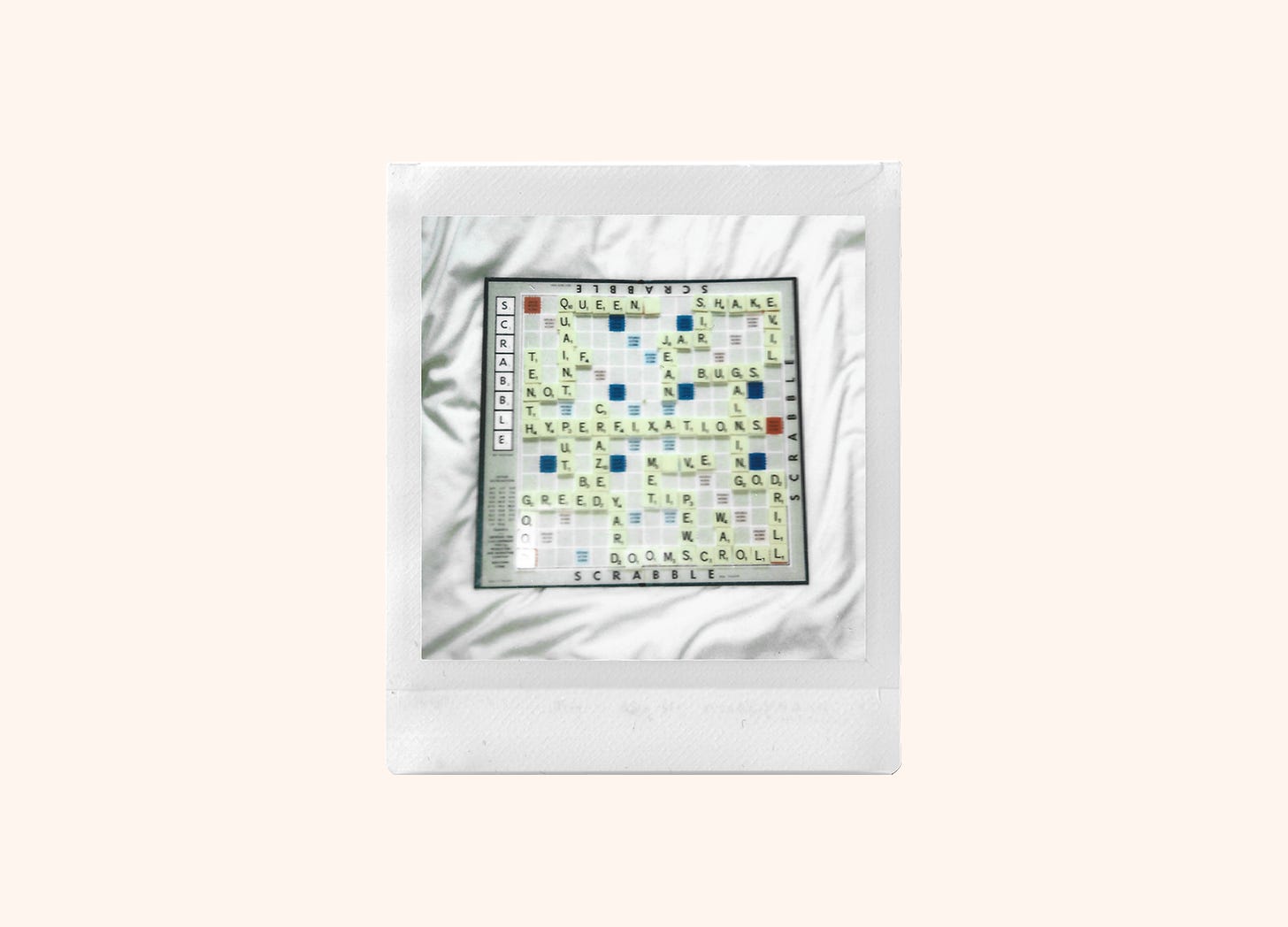
The Death of Colour
“PANTONE 11-4201 Cloud Dancer is a billowy white imbued with a feeling of serenity. An ethereal white hue, Cloud Dancer serves as a symbol of calming influence in a frenetic society rediscovering the value of measured consideration and quiet reflection. A breath of color whose vaporized and aerated presence gently illuminates and enlightens, Cloud Dancer is a whisper of calm in a noisy world.”
In an attempt to restore calm in a restless world, Pantone picked “a lofty white” as their colour of the year the first time ever, a bold decision that oscillates in the quantum superposition between apolitical naïveté and Machiavellian incitement. Of course, those of the “it ain’t that deep” persuasion will fervently remind anyone who’ll listen that it is just a colour. Unfortunately, the genetic consequence of erecting a system of racial capitalism has created an air of unrest and Pantone’s choice has greater implications than any of its well-meaning intentions to be “a calming influence”.
This year alone, a megastar was accused of selling necklaces that looks like nazi memorabilia. The internet cracked in two when the blonde one from the bedazzled Harmony Korine knock-off TV show became a conservative darling by doing an ad campaign about her “great jeans”. Whether you recognise these faux pas as intentional vies to white supremacists or tone deaf whoopsies is, at this point, irrelevant. It’s been nearly half a century since the Lee Atwater’s infamous Southern Strategy, decades upon decades of dog-whistling has given the western population racial tinnitus. Pantone’s choice is just another corporate question mark in a long line of question marks that are driving the world tribally insane.
Racial connotations aside, Pantone’s choice feels uninspired. It’s misguided attempt at meta profundity falls flat when you consider how minimalism has morphed into an exhibition of opulence, trickling down into the zeitgeist of good taste.
The sterility is chic.
Sometimes even the sun feels muted. You probably wonder why everything feels paler, whether this is what it means to grow up. It all used to feel much more colourful when you were a kid. Because it was. The world literally is losing colour.
Fear not, though. There is some reprieve. In a pirouette of fate, I discovered this short film by animator Raoul Servais in a wonderful ode to the playful rebellion of colour:
Verhoeven
It is probably no surprise that I love a good satire. The tongue luxuriates in the cheek with much of my writing. Anyone able to refract the absurdity of our civilisation through the prism of their own artistic pen is alright with me. But I’m also fascinated by the limitations of satire. When commentaries are stacked by layers and anti-intellectualism sweeps the population, comprehension stalls at the ground floor. What impact does satire have then? The consequences differ depending on the art.
When I was in primary school, I remember how my classmates thought Eric Cartman was the funniest part of South Park. British pre-teens discovering vulgarity as a new experience, shiny and gross, gravitated to Cartman without much thought or care. I didn’t find South Park funny, I was more amenable to The Simpsons. It wasn’t until I watched the Goobacks episode as a teenager that I started to understand South Park’s appeal. I could get on board with jabs at ignorant racists.
Matt Stone and Trey Parker describe themselves as “equal opportunity offenders”. South Park’s list of controversies is long enough reach the moon (or, at least, have their own Wikipedia page). They’re sole mission in life is provocation. There appears little care to speak truth to power. There’s is a crusade of chaos.
Great satire is biting, precise, and surgical. Some might say what South Park intends is a more unsophisticated execution, indiscriminate as an explosion. It’s funny when the bomb lands on something you hate but enraging when it lands on something you love.
I recently rewatched Robocop and Starship Troopers. I have a soft-spot for Verhoeven’s satire. Robocop is a more self-actualised endeavour than Starship Troopers which I think is tangled up by its own intentions. If you want to read more,
LetterBoxd Review of Robocop (1987)
Letterboxd Review of Starship Troopers (1997)
Keep reading with a 7-day free trial
Subscribe to Yours, Inigo to keep reading this post and get 7 days of free access to the full post archives.