

when wish-magic warps love
one wish willows, genies, bell hooks, obsessions, and longings

When Genie in Disney’s Aladdin (1992) begins to list the three provisos of his PHENOMENAL COSMIC POWER, we understand that his imprisonment in the itty-bitty living space of the oil-lamp means that wish-magic—like the Genie himself—is bound by restraints.
I can’t kill anybody.
I can’t make anyone fall in love.
“Can’t” assumes fulfilment of these wishes is outside of Genie’s expertise, power or magical ability—but this assumption of impossibility is complicated by a throwaway comment Genie makes about the third rule. After morphing the brilliant blue hue of his skin into sickly green, rot dangling like necrotic tinsel, Genie shakes Aladdin by the shoulders and says: I can’t bring people back from the dead. It’s not a pretty picture…
I don’t like doing it!
His exclamation implies that it is possible for him to resurrect dead people but his personal aversion supersedes the wish-granter’s entitlement. We can assume this logic applies to all of the provisos—that despite his cosmic enslavement, Genie has some level of autonomy to veto a small batch of wishes that he finds distasteful. How does this veto power work? Who allowed him to have it? If Aladdin wished for Princess Jasmine to fall in love with him, would he just deny it? Would he grant it but the wish would just fizzle out? Would some higher power step down from a celestial perch to sanction Genie if he granted it?
Wish-magic is presented cinematically as a primordial force, operating with its own principles of fundamental interaction but beholden to complications of sentience—of interpretation, misinterpretation and misappropriation. There is a space between the desire of the wish-maker, the motivation of the wish-granter and the quantum laws of the wish itself where magic becomes an unpredictable playground.
Here lies the unspoken stipulations. For example: Disney’s Genie can retract back into the lamp at any time but he can’t touch it. If he could, he’d’ve simply handed the lamp back to Aladdin when it came into Jafar’s possession. But the first thing Genie does when Aladdin sets him free is pick up the lamp—its glow of mystic energy made dull. He is stunned that something so ordinary had incarcerated him for so long. The Genie’s inability to touch the lamp was not a rule that affected the wish-maker so it never needed to be listed in Genie’s provisos, but it is a rule crucial to the flow of the story. It is a rule manufactured purely for dramatic tension.
This playground is also where morally bankrupt wish-granters thrive. In exchange for their wishes, a being like the extra-terrestrial felinoid Kyubey from Puella Magi Madoka Magica can recruit pubescent girls into being magical girls, dooming them for witchhood to convert their potent emotional energy to stave off the heat death of the universe. Or the Monkey’s Paw, popularised by W. W. Jacobs, can bend language and meaning to grant its wishmaker’s desires in the most unfortunate way possible.
But whether a wish is insidiously made, insidiously granted, innocuously made or innocuously granted—whether its the whimsical body-swapping of 13 going on 30 or the insidious Djinn who contorts every request into the most horrific outcome imaginable in Wishmaster—every parable of wish-magic has, in common, a cautionary tale about man’s own hubris, encouraging us to appreciate the humanity of being able to solve our worldly problems through the everyday determination of living.
Obsession
(I’m assuming that everyone reading this has seen Obsession)
There is a distinct passivity to Bear that immobilises him between knowing the right thing to do and his conviction to do it. This provides, I think, the most lucid commentary Obsession can offer about the state of masculinity in modern love. Bear is a poignant protagonist of our time because his passivity commits him to convenience over discomfort at any cost.
As the fictional object of our gaze, trapped in the contextual afterlife of a grim and decadent fairytale, we half-expect him to act valiantly, half-brace ourselves for him to crack into open malice. He proves many times over that he’s unable to do either.
Faced with this classic be-careful-what-you-wish-for wish, a conventional hero would take the supernatural premise in stride—with grit teeth, parabolic wiles, and a chivalrous sense of duty to save the woman he claims to love. But Bear reacts like any normie with greige prompt answers on Hinge—umming and ahhing until the consequences become too dire to ignore. That is the horror. His throwaway moments of timidness echo louder than the flippancy of his intent and he can’t rise to confront their ripples nor does he revel in their splashes of blood. He’s mid and it’s terrifying—because the circumstances so clearly demand more of him.
When real Nikki momentarily breaks free of the psychic clutches of Wish Nikki and pleads him to end her suffering and kill her, Bear can only bring himself to ask, “what’s so bad about being with me?” His question assumes a chilling, emotionally manipulative form that jolts his plausible deniability into a shirking of responsibility. His power over her solidifies and becomes transparent and it is here that he becomes Edward Burke’s triumph of evil, a “nice guy” doing nothing. But the something he needs to do, the resolution being immediately presented to him, is to become a murderer. He is being urged to kill for reasons nobody outside of the room would believe or understand. His question drips with hopelessness. He doesn’t have the compassion or the bloodlust to answer real Nikki’s pleas, or the moral constitution to end himself, or the competence to finesse a third option. And so, each sad action after flaccid inaction slowly perverts his life in a way you cannot look away from. Obsession edges us with possibilities of his redemption. But he is chronically unable to break free from the gravitational pull of misfortune brought about by his own corrosive avoidance of friction. Every decision is governed by an unbroken bass-line of desperation. Even when he finally chooses to sacrifice himself, which some might see as an overdue act of bravery or empathy, it is motivated by his frantic need to escape the untenable escalation of collateral homicides and manslaughters that would be too inexplicable to his friends, family, law enforcement and a grand jury. Offing himself is the most favourable outcome for him. It just happens to be best for Nikki as well; as the perpetual afterthought of his desire.
If One Battle After Another’s Ghetto Pat and Eddington’s Joe Cross are characters marking the ass-end of an era to represent “the dry-husked myth of the heroic ideal crumbling to reveal an incompetent loser beneath”; Bear is their Gen Z son, a loser in the imagination of a classically heroic patriarch, a loser in relation to the succeeding renaissance of antiheroes—the earthy charm of the mobster Tony Soprano, the cunning determination of the blue meth dealer Walter White, the suave machismo of the philandering Don Draper—and a loser to the amorphous, feminist ideal that yearns for a healthier model of masculinity altogether.
The One Wish Willow isn’t imbued with the lethal irony of a Monkey Paw; his friend Ian’s own wish for a billion dollars is granted as a consequence-free deluge of bank notes. Yet Bear’s wish for Nikki to love him “more than anyone else in the fucking world” manifests like a computational error—conjuring Wish Nikki, a supernatural entity piloting real Nikki’s body and holding her metaphysically hostage.
Bear’s wish is, of course, a clear violation of the second proviso in Aladdin and the events of Obsession hinge on our cultural remembrance of it, if not, the commonsensical understanding that making someone love you is ontologically fucked up. In lieu of a big blue Genie descending cancel or govern it—the insentient cosmic force of Obsession’s wish-magic warps Bear’s wish for love like the gravitational dilation of a black hole warps time.
In bell hooks’ seminal work on contemporary love, All About Love, she tries to locate a meaningful definition of what love. She first reaches for the words of Diane Ackerman:
“Love is the great intangible… Everyone admits that love is wonderful and necessary, yet no one can agree on what it is… We use the word love in such a sloppy way that it can mean almost nothing or absolutely everything.”1
Throughout All About Love, hooks pulls quotes and manufactures her own to try and discern what love is. Her north star comes from M. Scott Peck, who describes love as “the will to extend one’s self for the purpose of nurturing one’s own or another’s spiritual growth.”2. hooks describes the experience of genuine love herself as a “combination of care, commitment, trust, knowledge, responsibility, and respect.”3 In relation to violence in relationships, she states “when we understand love as the will to nurture our own and another’s spiritual growth it becomes clear that we cannot claim to love if we are hurtful and abusive. Love and abuse cannot coexist.” In relation to how children experience love as “only about getting your needs met”, she considers “the notion that love is about getting what one wants, whether it’s a hug or a new sweater or a trip to Disneyland, is a way of thinking about love that makes it difficult for children to acquire a deeper emotional understanding.”
But the most important definition comes, again, from Peck:
“Love is as love does. Love is an act of will—namely, both an intention and an action. Will also implies choice. We do not have to love. We choose to love.”
Wish Nikki’s existence is the result of a philosophical paradox between Bear’s romantic imposition and love’s imperative to be freely chosen. When we meet her, Nikki isn’t some out-of-reach object of Bear’s desire, she hasn’t “friend-zoned” him into some sin-bin of perceived emasculation nor is she callously leading him towards a humiliating bucket-of-pigs-blood. They’re good friends. They laugh together. They care about each other. Nikki says when she has a crush, nobody will know about it. There is a path to genuine love between Bear and Nikki, one the film intentionally presents as ambiguous and overrun with mundane, daily foliage.
But Bear’s wish for her to “love him more than anyone else in the fucking world” is, all at once, a robbery of the love that might’ve evolved naturally if he’d just taken the brave leap of confessing his feelings and the inception of a nightmarish ongoing violation of her consent. Whether you believe this makes him more tragic than heinous, vice versa, or what juncture in the timeline of events marks his spillage into irredeemability will likely provide as much fertile, ongoing discourse as Killmonger’s antagonism in Black Panther. To classify the film as an “incel horror” is too simple, too heuristic, too concerned with rendering male shut-ins who lack the social skills to endear women into casual sex or long-term romantic interest as the epitome of misogyny by looking away from the reality of Bear’s active social life and his brewing chemistry with his unfortunate co-worker, Sarah.
Obsession’s narrative is sustained by the popular mischaracterisation of possessiveness as “love”, trafficking the obsolete yet persistent notion that an unhealthy fixation indicates an overwhelming volume of romance. We have not yet matured past the myth that “loving too much” is an explanation for intimate partner violence, as hooks points out how normal it is to refer to men who kill their wives and girlfriends as a ‘crime of passion’:
“He killed her because he loved her so much. If we were constantly remembering that love is as love does, we would not use the word in a manner that devalues and degrades its meaning.”
Wish Nikki never intentionally harms Bear but her actions in the name of love drive her to humiliating self-neglect, claim the lives of his friends, and lead Bear to such distress that he kills himself. These are devaluations and degradations that prove how Wish Nikki treats Bear is not the noun of love but a malformed version of it, one we know deep down is a bastardisation and one we are all too comfortable conflating with “genuine love” in the way that Ackerman aptly describes as “sloppy”.
Where Bear’s wish and misogynistic ongoing violation of consent is the film’s narrative ignitor and fuel; Wish Nikki’s perpetuation of the “loving too much it results in violence” myth is the engine, echoing colonial ideas of love as property ownership. Together, of course, they make the horror of Obsession compelling. But beyond the creation of Wish Nikki being unnatural or assigning any moral value or blame to her actions borne out of Bear’s impulsive and insecure desire—her very existence exhibits the wish-magic’s failure. Wish Nikki does not truly love Bear because, as hooks states, “to practice the art of loving we have first to choose love.” Nothing about Wish Nikki is out of choice. Nothing she does is out of choice. She is functionally a slave, existing simply to keep him “loving” her, or to get him to “love” her more, or to eliminate the romantic interests that he might grow to “love” more than her. Wish Nikki is forced to experience what hooks describes as, “a process of investment wherein someone becomes important to us called “cathexis”, she is magically trapped in a state of perpetually confusing “cathecting with loving”. If we to take these meanings seriously, it means admitting that nothing Wish Nikki did constitutes as love. Thus, Bear’s wish was never truly granted.
Three Thousand Years of Longing
(I’m assuming that everyone reading this hasn’t seen Three Thousand Years of Longing)
In a hotel in Istanbul, a professor of Narratology Alithea Binnie—played by Tilda Swindon—rubs on her newly purchased antique Çeşmibülbül (or “Nightingale’s Eye”) and unleashes Idris Elba’s Djinn within. As is custom, The Djinn offers Alithea three wishes—with the caveat that they must be what her heart truly desires.
The provisos of these wishes are:
No wishing for more wishes.
No wishing for immortality.
No wishing for an end to sin or suffering.
Alithea believes herself to be content, whole and desiring nothing. So Djinn appeals to the curiosity that drives her vocation by regaling her with tales about his life.
First, of being in love with the Nubian Queen of Sheba—the most beautiful woman in the world—and being betrayed by the jealous King Solomon who magically imprisoned him in a brass bottle, throwing it to the bottom of the Red Sea.
Second, of being found by a concubine of Sultan Suleiman the Magnificent and, after being entangled in a web of family betrayals, with bad fortune leading to his re-imprisonment in a bottle at the bottom of Bosporus Strait.
Third, of being discovered by Zefir, a young woman trapped in a loveless marriage with a lecherous husband in late 18th century Turkey, who wished him for knowledge. Djinn taught her languages, astronomy, philosophy and granted her an enviable library of books that she read voraciously, making her smarter and more inspired than Galileo and DaVinci. Djinn and Zefir fell in love. Zefir was plagued by a mathematica that she believed would “explain the forces that bring space and time and matter into being” but it existed at the far reaches of her ability to conceive as a human, on the tip of her intellectual tongue. Djinn suggested she use her second wish to “see” like him, to “dream awake as Djinn do”. This allowed Zefir to discover electromagnetism, the “subtle fire” that Djinn are made from. Zefir fell pregnant with Djinn’s child and she begins to find the curse of his ensnarement feel like her own. She began to feel as trapped with Djinn as she did with her husband. In the throes of anger one day, Zefir used her final wish to forget Djinn ever existed just was he’s retracting back into the bottle, again, trapping him for centuries.
Upon hearing these stories, Dr. Alithea realises that she, too, is in love with Djinn. She makes her first wish: I’m here to love you. And I wish for you to love me in return. Her voice quivers as he pulls her closer, “is it too much? is it all too much to ask?”. Djinn doesn’t answer, he just lifts her up, pulls her close as her robe falls to the floor.
They kiss and vapour erupt from Alithea’s mouth.
The colourful wisps swirl like the surface of Jupiter and form a dream sequence where the hotel room becomes suspended in a cosmic void and the windows that previously viewed the Turkish day are filled with the familiar darkness of space with its pinhole stars and nebula clouds. Alithea delivers a narration:
“How can I persuade you that I once found love with a Djinn? In any case, few would believe me. Love is not something we come to by reason. It is more like a vapour. A dream, perhaps, to lure us into the enchantment of our own stories…”
Djinn, big and dark and hulking, embraces from behind Alithea, tiny and frail and drowning in his arms.
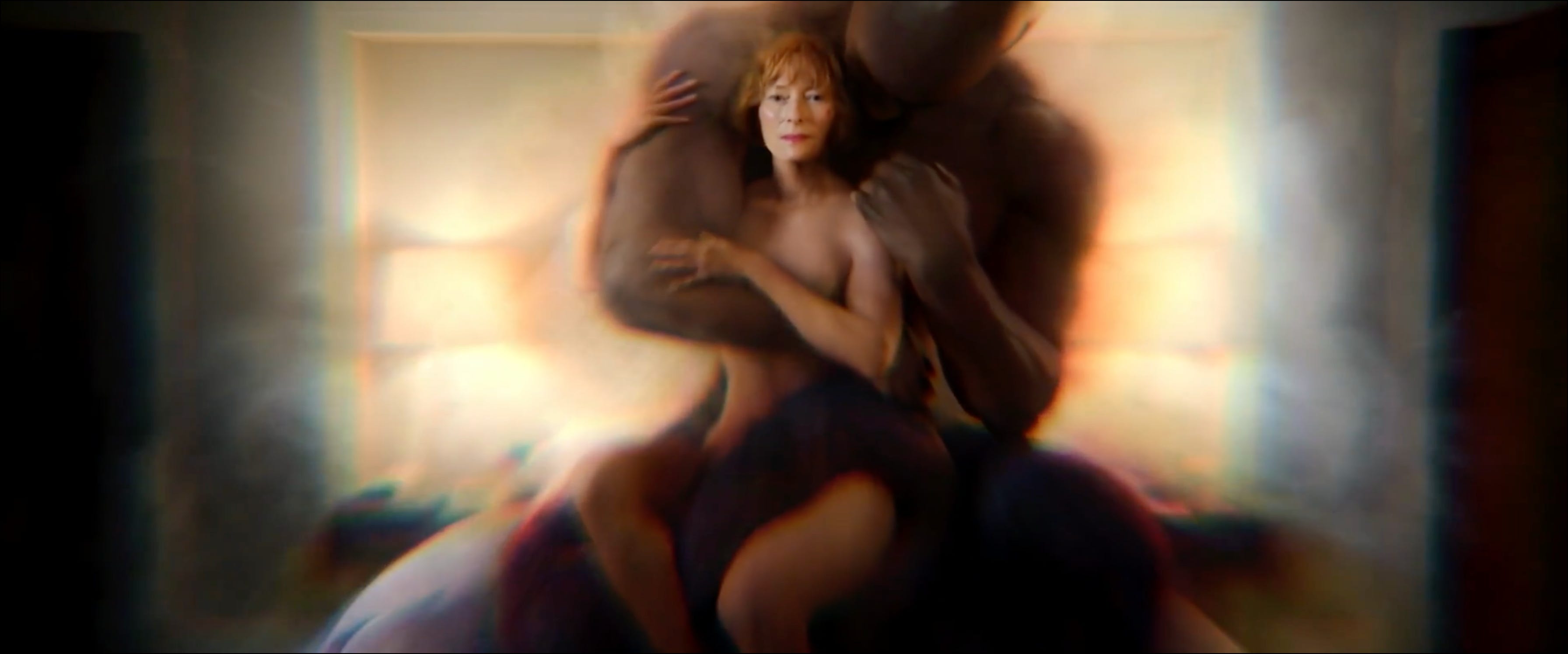
…If that’s so, how are we to even know if its ever real? Is it a truth or simply a madness?
When they return to England, Djinn stands in the garden looking out towards the sky with a phone tower in the distance. “The air is thick here,” he says. “All your ingenious devices, murmuring at one another.”
Curious to how Djinn is experiencing the world, Alithea presses her head against his and all the sounds, sirens and conversations of the city flood her ears with cacophony. “You hear all that?” she asks. “I also see it.” Djinn responds. Once again she asks, “Isn’t it all too much?”
“I am a Djinn, I can adapt.”
The pensioners next door, Clementine and Fanny, call out and Djinn vanishes. The two, old women immediately heckle Dr. Binnie’s exotic vocation before bloviating about how Britain is being “overwhelmed with ethnics” from their neighbouring 3 story-balcony like Reform voter versions of The Muppet’s Statler and Waldorf. Days later, Alithea knocks on their door and offers them a bowl of chickpeas, cloves and pistachios before introducing them to Djinn. Their gaze lingers on him with… Surprise? Suspicion? Glee? Lavisciousness?
Alithea and Djinn live together peacefully for a time. Alithea goes to work and returns home to embrace Djinn, who remains in wait. Sometimes, he travels the world—observing brain surgery operating rooms, hadron colliders, and massive satellite dishes, always returning to converse with her at nightfall. “Hate prevails. It metastasises and outlives love. I just want to talk about love.” She says, one evening.
“Such a mess of contradictions, all of you”, he chuckles.
Returning home one day to the air speckled with gilded dust, Alithea finds Djinn in the basement with his mouth crusted over, unresponsive. She uses her second wish to ask him to speak to her. His jaw cracks apart like it is fated to fall from his face and he springs up, glitching and planning picnic dates and flitting into indecipherable languages. The modern world’s abundance of electromagnetic fields, it seems, is slowly gnawing at him on a cellular level. His face crumbles and Alithea realises she must let him go.
“Love is a gift, a gift of self given freely. It isn’t something someone can ever ask for.” She tells him. “I tricked us both. The moment I spoke that wish I took away your power to grant it. I, more than anybody, should’ve known that.”
She makes her final wish: for him to “go where her belongs, wherever that may be.” The Çeşmibülbül rattles, breaks, and melts into clear, thick fluid.
Three years later, she finishes her novel—Three Thousand Years of Longing. Djinn has moved to the dimension with his kin but every so often he returns to the world of humans to visit Alithea.
“And they would grasp each vivid moment. Despite the pain of the raucous skies, he always stayed longer than he should, long after she begged him to leave. He promised to return within her life time. And for her, that was always enough.”
It is impossible not to compare the inciting wishes of Obsession and Three Thousand Years of Longing. Where Bear is careless and dubious of the One Wish Willow’s chances of success, Alithea’s love-wish is made lucidly, the djinn materialising from the Nightingale’s Eye is certain proof her desire will be fulfilled.
Despite the ways Obsession relies on mischaracterising possessiveness as love, the film still manages to understand that, fundamentally, making someone love you is ontologically fucked up. The narrative arithmetic reflects this through its choice of genre as horror and by concluding that it’s not enough for real Nikki being set free from her body-snatched nightmare—Bear also needed to die for making his wish and, perhaps more importantly, for not finding a way to break the spell. His demise is part of the moral catharsis.
But there is little moral catharsis for the ontological fuckedupness of Three Thousand Years of Longing. Alithea’s wish begins an ongoing violation of Djinn’s consent and she immediately launders her coercion through guilt-ridden concern, asking “is it too much? Is it all too much to ask?”
When narrating her reflections on love’s true nature, she refers to love as a “vapour”, defining it as a nebulous thing that’s “impossible to come by with reason” in a way Ackerman would rightfully diagnose as “sloppy”, to rationalise what is clearly cathexis—driven by novelty and awe at Djinn’s magical otherness, and perhaps even governed by a racialised envy towards Djinn’s beautiful and brilliant past nonwhite lovers. When she makes her final wish for him “to return to where he belongs” she laments, “Love is a gift, a gift of self given freely. It isn’t something someone can ever ask for.” She believes she asked Djinn for him to love her in return but her position as the Genie’s master dictates any grantable request is indistinguishable from directing an order.
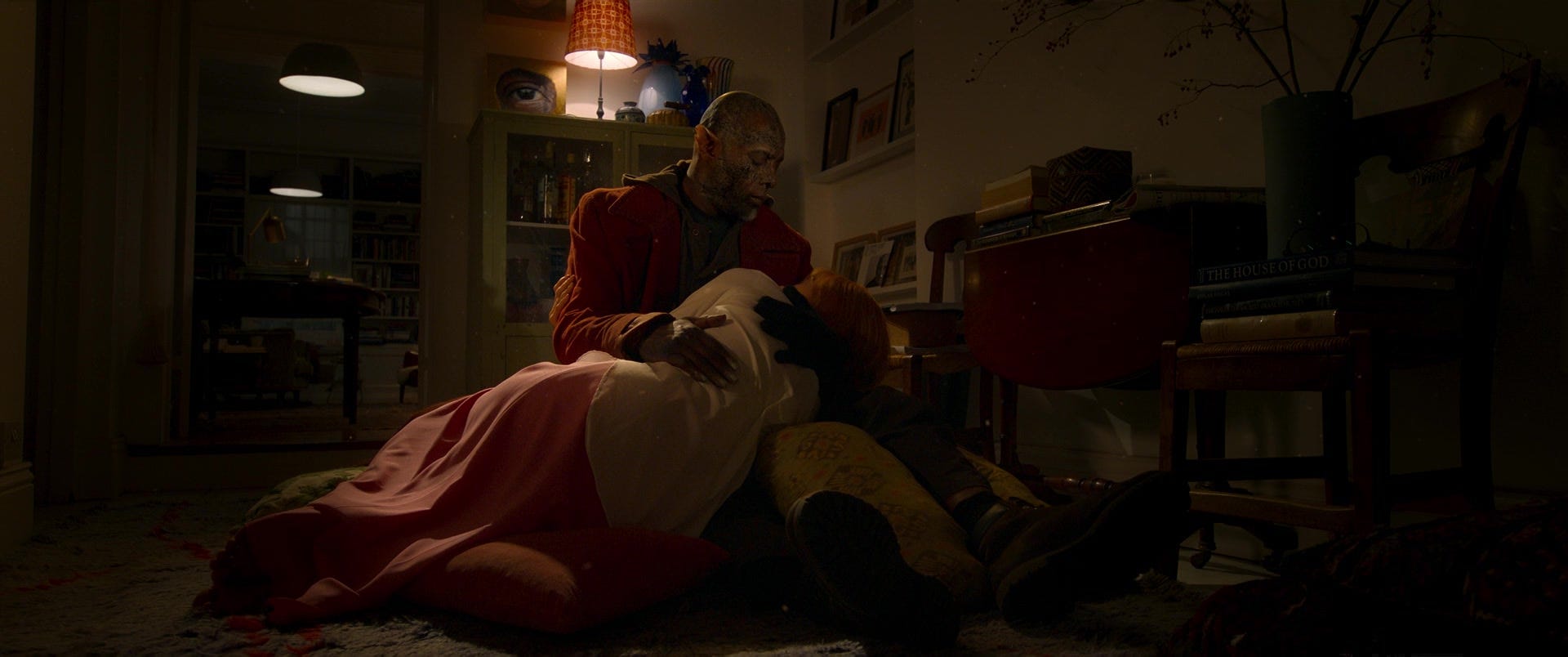
Alithea’s declaration that “love is a gift of self given freely” materialises out of nowhere, it isn’t a organic realisation but a response to seeing the object of her desire crumbling from the unrelated effects of the modern world’s electromagnetic torture. Her unearned moment of personal growth solves the narrative problem of moving the film into its final act but does little to resolve the moral obfuscation that the entire “love story” is based on in the first place. How can Three Thousand Years of Longing not recognise the ontological fuckedupness of its own romantic premise?
Afropessimism would theorise that Alithea and Djinn exist in a master/slave dynamic even without the magical obligation of geniedom. Alithea’s whiteness precludes her from seeing the blackness of Djinn as anything other than property long before she rubbed the Çeşmibülbül. The hierarchical structure of geniedom only exacerbates this. Despite her assurances to Djinn that she is content, Alithea is profoundly starved of love and we can call on bell hooks once more, “in a world without love the passion to connect can be replaced by the passion to possess.” Djinn’s materialisation into Alithea’s care as Genie beholden to her revives a historically colonial dynamic, one technically and legally abolished but libidinally dormant in the collective white psyche. He, in every way that matters, is her property.
Exploring what Professor Tamari Kitossa has dubbed the “Black Phallic Fantastic”, a sociological concept that “summarizes a contradiction that both reaffirms and intensifies the domination and positional inferiority of black men,” Kitossa infers that bestial representations of black men harken all the way back to ancient Greek mythology where “the chief function of the satyr was to signify the barbarous status of African men and to represent a morality tale for disciplining recalcitrant women.”4
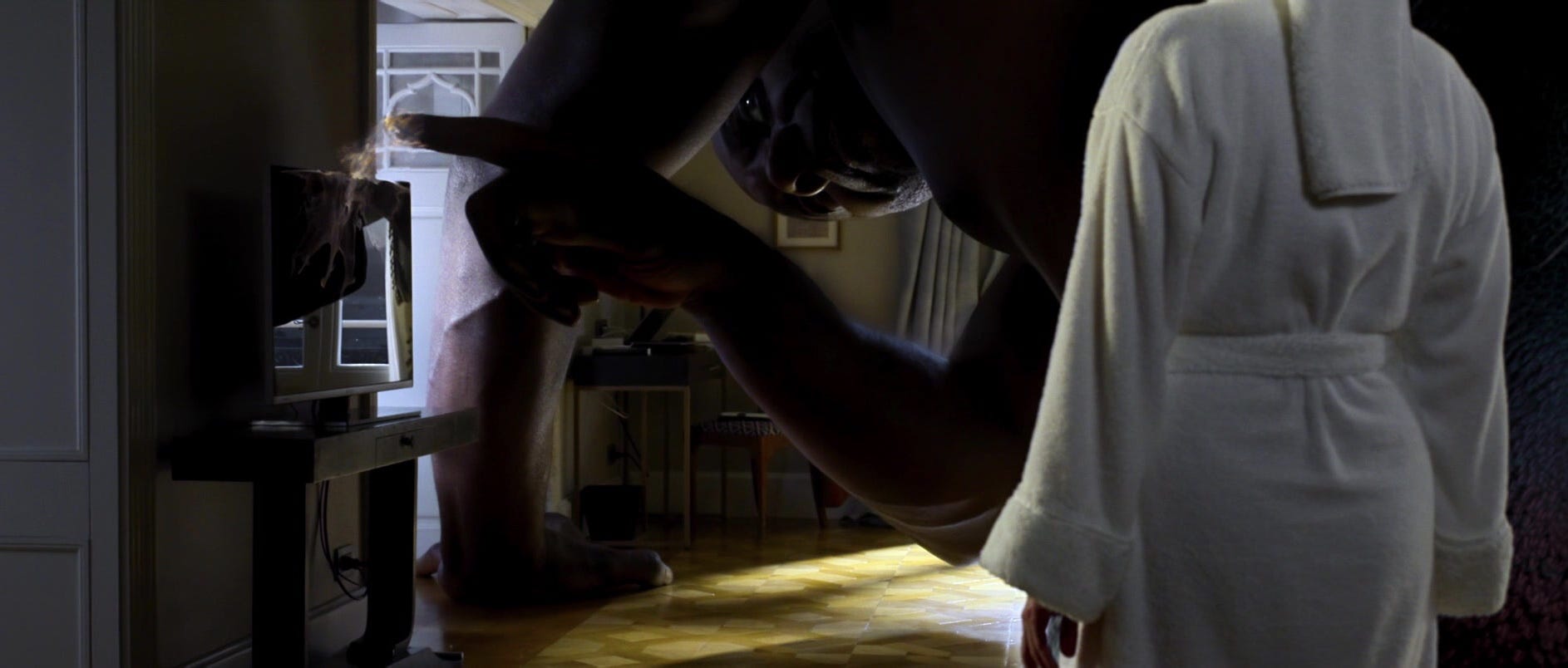
Every chance it gets, Three Thousand Years of Longing presents Elba’s Djinn as large, shadowy and imposing. His ears are pointy, his legs are layered with thick glades of dark and shimmering fur. The satyric animalism and embellished massiveness of his body traffic the optics of “the black brute” as a visual distraction from the reality that Djinn is completely at the mercy of his small and dainty white female master. Her desire for Djinn to “love her in return” is, as we’ve already established, not a wish that is meaningfully achievable by the wish-magic’s cosmic laws nor is it born out of any expression of genuine love. Any desire she has can only be practised as an affectionate “ethic of domination” that confuses cathecting for love, it is closer to a libidinal expansion of the power she already has over him; manifesting her heart’s desire to possess him in a more insatiable way.
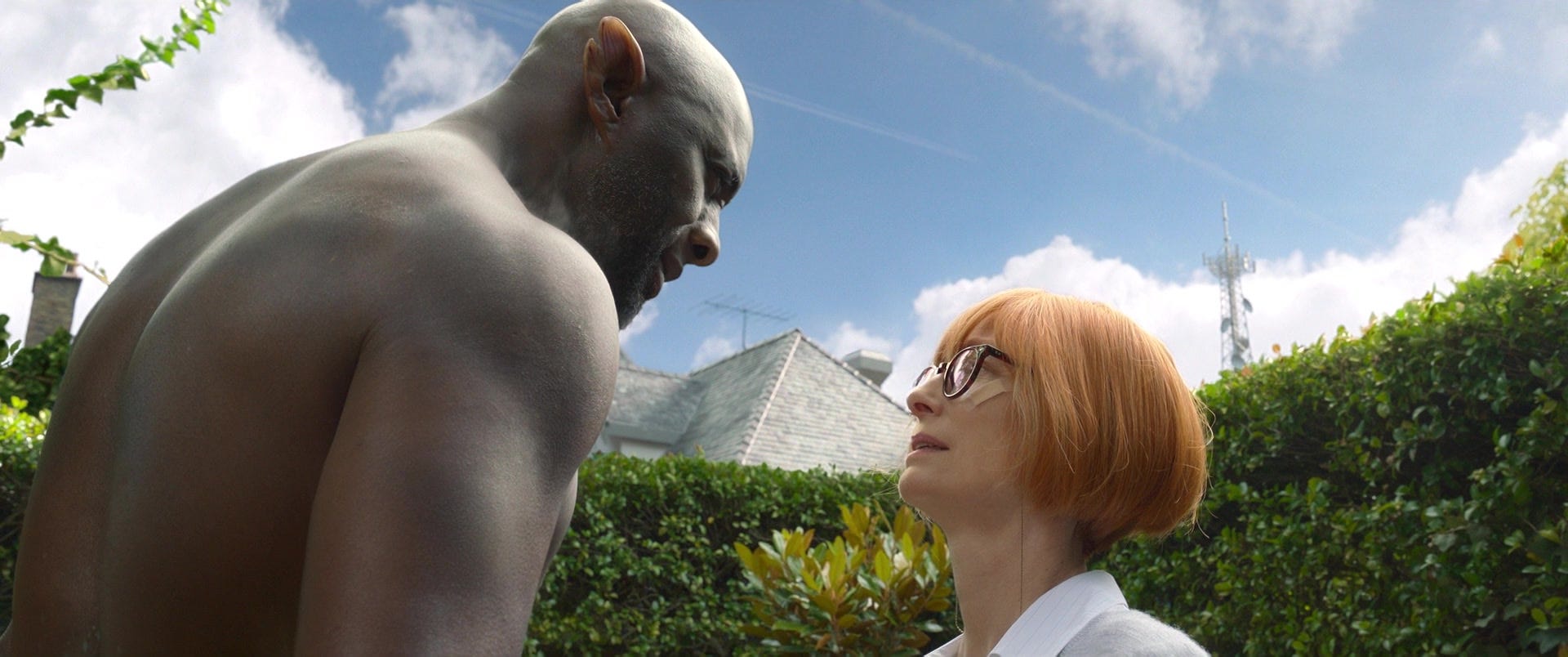
How does Djinn feel about his coercion? The better question is: how would we even tell? Djinn is impenetrable, barely expressive, he maintains a constant cordiality through his nondescript Middle Eastern accent that makes it impossible to differentiate his own passion from his cosmic obligation. He expresses no grief towards missing the birth and life of his half-djinn child, no interest or curiosity about the fact his child’s djinnish blood might mean that they’re still alive.
After Alithea’s wish, Djinn initiates the only act of erotic intimacy in the hotel room of Istanbul that reminded me of a passage from Katerina Deliovsky’s essay about white women and sex tourism:
“Darker-skinned men are more highly valued and generally preferred by sex/romance tourists because they are perceived to represent the tropistic, hypersexual black stud… Significantly, the scholarly works examined here note that neither party considers their sexual interaction to be prostitution or to fit the label “sex tourism,” even though others may label it so.”5
From Alithea’s perspective, Djinn’s initiation of intimacy could appear like consensual agreement to the wish. But we could easily interpret it as Djinn being coerced to begin the performance of his obligation (vagueness vs. ambiguity). Djinn is made to be faithfully appear complicit in his own coercion, their entire relationship embodying a kind of tourism that neither of them would think to label as such.
Alithea’s wish inspires no observable change Djinn’s demeanour, no resistance and no joy, no internal conflict or fracture of personality. This is a djinn who loved the most beautiful woman in the ancient world, who fell for someone who became one of the most brilliant minds to walk the earth and he simply succumbs to a white woman PhD lecturer of Narratology from 21st Century England without protest, question, or enthusiasm. Perhaps, the heartbreak his prior romances meant he was open to something different, plainer, more ordinary. But we will never know because the “love” was imposed on him and he is characterised to simply endure it. We don’t know what he wants. We cannot tell where Djinn begins and Alithea’s wish ends. We don’t even know if Alithea’s final wish for him to “return to where he belongs” cancelled out her love-wish. With his Çeşmibülbül broken—we don’t know if he continues to visit her of his own free will or if he’s still obliged to return her love (wish 1) and speak to her (wish 2). We do not know—because Three Thousand Years of Longing is not concerned with imagining or interrogating how the ontological fuckedupness of Alithea’s coercive wish affects Djinn any more than it is concerned with giving him a name beyond the designation of his mythological species. Djinn exists only as an accessory to Alithea, indistinguishable from a pet or the glass Çeşmibülbül that housed him. And the fact we do not know if Alithea’s ongoing violation of Djinn’s consent is even over inadvertently makes Three Thousand Years of Longing a more potent psychological horror than Obsession.
Conclusion
The wish-magic of stories represents our endless, imaginative capacity for desire. We see flecks of it in our small, everyday hopes, imbued in scratch-cards, lottery tickets and Omaze raffles. To dream of a fulfilled wish requires a sophisticated inventory of our own lack and satisfaction. How many of us fall into some crude binary of lacking or being satisfied by love?
Yet, if you were to wish for someone to hate you, or for someone who already hated you to like you, would we afford as much of a profound interrogation as we would love? There is something sacred and complicated about love that wish-magic is doomed to never solve.
Where we established Genie’s rule against bringing people back from the dead is driven by his personal squeamishness, the inability to make someone fall in love with you seems like a genuine impotence of the magic itself. It is not that wish-magic warps love like a black hole warps time with gravitational dilation—it is that love is wish-magic’s elemental kryptonite, they are the antithesis of each other, an immovable object and an unstoppable force. Love is a cosmic law that wish-magic cannot break so it must conjure something else entirely—this is what makes Alithea’s wish appear so insidious, this is what ends up “corrupting” Bear’s. It is impossible for love’s liberty and a wish’s enforcement to reasonably coexist. Love is our greatest expression of freedom and an expressed wish is our greatest desire for control.
“Love is the most important thing in our lives, a passion for which we would fight or die, and yet we’re reluctant to linger over its names. Without a supple vocabulary,
we can’t even talk or think about it directly.”
— Diane Ackerman
“Love is, in fact an intensification of life, a completeness, a fullness, a wholeness of life.”
— Thomas Merton
“Love is an action, a participatory emotion.”
— bell hooks
“When I speak of love I am not speaking of some sentimental and weak response. I am speaking of that force which all of the great religions have seen as the
supreme unifying principle of life. Love is somehow the key
that unlocks the door which leads to ultimate reality.”
— Martin Luther King Jr.

M. Scott Peck, 1978 — The Road Less Travelled