

james bond should stay dead
BAIT, meta-commentaries, co-option of the black experience, imperial super-spies


While Roxana Hadidi’s review of Bait observes how the dramedy series “resuscitates the much-debated question of whether a POC actor should play James Bond”, her use of the abbreviation resuscitates a debate of its own.
It is no secret that speculation of a nonwhite Bond has been embedded in the cultural memory by way of Idris Elba and although granted; 2024’s Monkey Man drifted the British Gujarati heart-throb Dev Patel into the gravitational pull—it is inexact, perhaps even disingenuous, to conflate this “much-debated question” as a broadly POC experience when it has been noticeably asked of, and distinctly sustained, by black British actors. (CC: Damson Idris, Aaron Pierre, Regé-Jean Page).
There is a mean-spirited version of this essay that exploits this distinction by nunchucking banal representation politics to argue that Bait’s core premise is problematic because it appropriates a black anecdotal experience and reupholster it as South Asian via its protagonist, Shahjehan Latif. It’d probably be able to incite the type of culture war discourse that is a mainstay in the Malebolge formerly known as Twitter.
Such a piece would require investing in the perspective that the show would be better, more accurate, or more compelling if it were explored by a creator with a black face rather than a brown one, and the concluding paragraph of one of my essays from 2021 articulates why that perspective isn’t particularly appealing:
No Time to Die is a fitting end for Daniel Craig. He brought an emotional dimension to the role that hasn’t been explored before him, yet his tenure ends at a time where western society is noticeably shifting, confronted with the social harms of yesteryear and debating drastic steps such as abolishing the police. James Bond mobilises against his rogues gallery of maimed villains who want to thwart the existing superpowers but when it comes the banality of everyday evil—of climate change threatening the future of our species, of income inequality that leads to mistaking overpopulation with over-consumption, of a white supremacist structure that has split the planet into 1st, 2nd and 3rd worlds, of ableism that discards those not in peak physical condition or attractiveness as unproductive and/or immoral, and so many other ways that the world is battered and broken—Bond is never dispatched. Because he exists to preserve the status quo. There are many questions about what should be next for Bond. Can a woman writer redeem him? Should he be a black man? Can Bond be a woman? As Lashana Lynch ends No Time to Die with the 007 title in her grasp, there seems to be far more pressing questions to ask: In the slow march towards a more equal world—is there even a necessity for a British imperial super-spy or a culture that venerates him? Does the status quo Bond has upheld for so long need upholding? Does James Bond even need to exist at all?
The most laughable part of Anglocentrism is how desperately it claws for immortality; founding its supremacy through slaughter and theft, cobbling laws together to protect its spoils and working multilaterally to keep reselling the illusion that a dominance wrought by barbaric violence can remain perched safely at the top of the world forever.
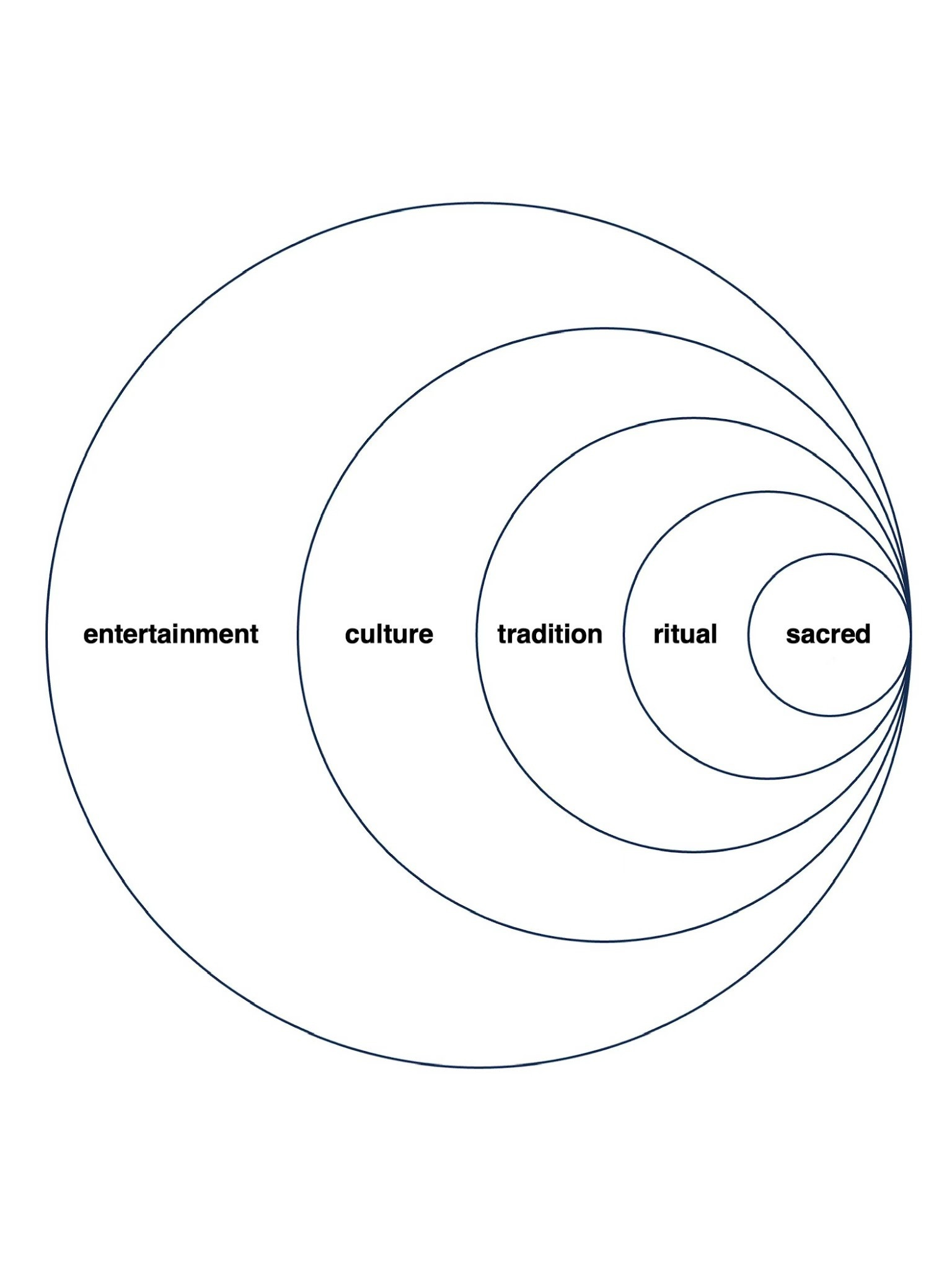
Borrowing from rina nicolae’s above anthropological diagram of kissing circles, we can glean that Bond drifts between the white space of entertainment and tradition, flirting with ritual in the sense that he’s the cinematic equivalent of a statue; a quasi-religious symbol of reverence erected to invoke fond memories of a mythologised past that a great many will pilgrimage to the movie theatre to see, built with hardy materials intent on prolonging anglophilic power-fantasies across any arduous ravines of time.
Speculation of his race produces a metronomic binary in the public consciousness where a Bond with black skin represents novel progressivism and a Bond with white skin represents classic traditionalism. But the binary doesn’t exist. The much-debated question of a nonwhite Bond is just a thin slice of a much rounder effort to decide how much the 007 statue needs to shape-shift to increase the odds of itself, and the anglocentric dominance it represents, of lasting forever. The option to let Daniel Craig’s Bond stay dead is so unconscionable that the British production company that has licensed the franchise since the 1960’s relinquished creative control to Amazon MGM just to weather the changing tides.
Bait aids the survival.
There is a scene in the Goldeneye where Judi Dench’s M calls Pierce Brosnan’s Bond, “a sexist, misogynistic dinosaur, a relic of the Cold War”. The self-aware criticism made inside the film helped distance Brosnan from the chauvinistic statue(s) of Bonds that came before him and in a 1995 Washington Post review, Desson Howe points out:
There’s another politically correct moment when Miss Moneypenny (an old character played by new actress Samantha Bond) playfully informs 007 that his flirtatious comments are grounds for sexual harassment.
“What’s the penalty?” he asks.
“Someday you’ll have to make good on your innuendos,” she says.
In other words, Carry on Bond, old boy. Do it for the Empire.1
Goldeneye was a massive success, revitalising the franchise for the 1990’s. Variety Critic Todd McCarthy praised the film for “breathing fresh creative and commercial life into the 33-year-old series”. Roger Ebert commended Brosnan’s Bond as being “somehow more sensitive, more vulnerable, more psychologically complete.” The sexism got a patch update and the statue took on whatever grooves and contours it needed to survive the new whims of the 1990’s.
Bait is the racialised version of Judi Dench’s feminist insert. It wants to make a point but is bound by contractual obligation to deliver that point in a way that only benefits the franchise. Fatimah Asghar reflects on how this contrasts with a show like Donald Glover’s Atlanta:
“What I loved about Atlanta, was that structurally, the show presented a bait and switch. It hooked audiences with a pilot that tricked us into thinking the show would go one way, but then pushed against that. Donald Glover has talked about Trojan Horsing the show past the executives, because they knew that executives wouldn’t let a show like theirs exist on air. Unfortunately, Bait seems like the exact kind of show white executives want on air, because it holds up a status quo while giving a dated and underbaked racial argument.”2
Bait wants to seem transgressive, it wants you to recognise Shah’s tête-à-têtes with a talking pig’s head surrealistically portray the psychological unravelling of a British Pakistani actor plagued by familial tensions, intracommunal collisions and the grander impositions of white ideals but, in the process, displays a constant willingness to entertain James Bond as a white mythology worth unravelling over. The entire show is suspended, like Dench’s M is, in a prison of its own complicity—where it is able to “call out” Bond’s gross behaviour but it must treat him with begrudging respect because, ultimately, he gets results. Carry on Bond, old boy. Do it for the Empire.
Of the things the show wants to say, Bait is suspiciously committed to satirising sell-outs; whether it’s Sid, the protestor-influencer who cares more about social media clout than his activist cause or Yasmin, the cultural critic ex-girlfriend who pens a Guardian essay entitled No, Shah Latif, We Don’t Need a Brown Bond and claims Shah would “be white” if he took the job before its revealed that she’s moving to Argentina with her new white boyfriend named Oliver Winthrop.
Any character shown with political principles is revealed to be a hypocrite and it’s depressingly nihilistic—not because “selling out” is morally incorrigible but because it is nauseatingly common, to be a nonwhite immigrant in the heart of empire means to make concessions every single day; the tongues we must bite, the trespasses we must let slide. It would’ve been nice if a show like Bait, that positioned itself as a tongue-in-cheek uppercut to a white relic, could’ve provided some thoughtful reprieve, or some courageous alternative of imagination from, or challenge to, these daily forfeitures. Perhaps, the intention was to imbue these characters “selling out” as complicated by making them contradictory but it lands hamfistedly, communicating an almost conservative cynicism that treats anyone with even a whiff of anti-colonial politics as frauds concealing their own selfish wants.
The show’s desire to be disruptive stents at the level of superficial provocation. I’m sure the cinematic shots of a Muslim Bond will undoubtedly piss off Reform voters and Unite the Kingdom Marchers but its sense of self beyond this bear-poking feels innocuous; ambiguous in a way that seeks to conceal more than it wants to dig up and uncover; and the end result is a well-produced, highly-stylised rust removal service for the monument of Bond dressed up as an introspective meta-commentary.
That is why there’d be little point in me pursuing the argument that Bait should be a black show just because its core premise has been borrowed from black actors’ experiences. It wouldn’t be compelling to watch a black brit polish off a Bond statue either. While Bait tries to reckon with how it appears in the unnaturally reflective surface of whiteness, it conversely, doesn’t seem concerned with reckoning with blackness very much at all.
It’d be melodramatic to say the show is antagonistic of blackness. Rather, it transgresses ever-so-slightly—with subtle extractive conflations and convenient erasures that add to the arithmetic of black life enduring a continuum of transactions that arc towards loss. This is no more apparent than in the name of the series itself.
“Bait” originates from black british english; its elasticity as a word is reflective of how black languages across the diaspora—from pidgin to patois to ebonics3—remix english to give it more prismatic dimensions. (CC: “Sunn m'Cheaux on the habitual be”).
“Bait” can mean: annoying in a particularly transparent way (don’t be bait), derogatorily obvious (that’s bait), to expose (don’t bait me out) and generally, denotes being outed in a manner that is embarrassing. It is a term inexorably linked to the early renaissance of UK grime.
Like black americans, black brits have historically suffered from what we can call “a mimetic desire of coolness” which manifests linguistically as the youth cultures of other racial communities—Pakistani, Turkish, Polish and even bog-standard English—drawing in black vernaculars into their own, everyday speech. There is something to be said about how this ‘drawing in’ is predominantly practiced by nonblack men—which relies on a libidinal comprehension of blackness as hyper-masculine, and it is not too far-fetched to suggest that the process of nonblack men’s ‘drawing in’ of black mannerisms and language could be seen as an performance of racial machismo4.
After years of being pejoratively named “roadman slang”, black british english has recently undergone a sanitisation process resulting in the emergence of linguistic category in british academia: Multicultural London English (MLE):
The misidentification of Black British English as MLE minimises the cultural value and influence of Black heritage in modern-day Britain. BBE was formed exclusively and independently through the Black British experience. By stating words like “wagwarn” have multicultural roots, this discredits its Jamaican origins. The mere usage of words from other languages like “Kettle” – a Cockney word for watches, that has been further used and popularised by BBE Speakers does not justify the naming of BBE as multicultural London English or slang. Instead, this shows that BBE mirrors the established linguistic norms of borrowing terminology from other languages known as cognates, which can be seen within White Mainstream English in words such as ‘café, which is originally a French word. — Statement from Black Learning Achievement and Mental Health
There is, and will continue to be, endless arguments about how nonblack people adopt black linguistics. Defenders will pronounce that it is a matter of proximity, an environmental osmosis. Objectors will recognise how it is subject to code switching, and theorising that non-black speakers of “don’t talk like that around their family.” These discussions inevitably descend into a referendum of who can speak how—which is generally uninteresting and unproductive because it is utterly unpoliceable. Nobody can control how brown people—or black people for that matter—speak.
But if we are to assume the best faith we can, Bait borrows from black british sociality as a nod of solidarity—a recognition of a shared struggle—what is interesting in a work like Bait is the absence of active solidarity with blackness and what can be gleaned from it.
Bait’s title borrows from black british english.
Bait’s premise borrows from the public backlash against Idris Elba.
These experiences of black sociality are used as narrative kindling in a way that is reminiscent of political blackness—an umbrella identity like “people of colour” that socially organised African, Caribbean and Asian diasporic communities in 1970/80s britain into a unified, anti-racist bloc.
Kehinde Andrews elaborates:
Political blackness was meant to be a strategic essentialism that united those who experienced racial discrimination. However, the concept was flawed from the outset, misunderstanding the complex nature of racism and rooted in a perspective of non-whiteism that normalized whiteness… This is not an argument for abandoning collaboration in the struggles of different ethnic minority groups; rather it is a case against the unnecessary and counterproductive mobilization of a catch-all term that is incapable of building the widespread, grassroots unity it desires. Perhaps the most serious flaw in the British context is that the wish to avoid disunity between ethnic minority groups has meant that political blackness has delegitimized Blackness rooted in a connection to the African Diaspora.5
In episode 3, Shah’s mother, Tahira discovers Shah’s agent is black woman named Felicia and proceeds to say in Urdu, you never told me your agent is a black lady. The words “black lady” are clearly audible in English. Shah shoos his mother away before apologising and says, “but you are a black lady, though”. Felicia responds, “I know.”
The scene feels like it is trying to reach for admission of how anti-blackness lingers in the older, diasporic Pakistani generation but it falls flat and lands awkwardly because it is too ambiguous about its intentions for us to make any sense of the commentary it is trying to make and not funny enough to justify its own short runtime.
If the scene is reaching to acknowledge the anti-blackness of the older, diasporic Pakistani generation, it throws the elders under the bus while deflecting responsibility away from any introspection about how Shah’s generation interacts with blackness, no interrogation of why South Asian manhood requires an absorption of blackness to affirm itself. Instead, there is a cringe sequence where anti-blackness is this vague prick that Shah is absolved from doing anything about. Felicia doesn’t speak Urdu, nor does she have the audience’s privilege reading the subtitles to see what Tahira said. If you put yourself in Felicia’s POV, she has no idea what was said about her, and all that’s left is a strange aftertaste of knowing the only black person on the show endured a racialised comment about her in a language she did not understand. The most disappointing thing: the exchange doesn’t add anything—its just a Wile E. Coyote road leading to a horizon painted on a cliffside.
There is a tendency in the United Kingdom for black and brown immigrants to affirm their Britishness vigorously, to plant their feet like a flagpoles and declare that they belong. I always wonder how much the need for emphasis comes more from pride or fear. Pride in belonging, pride in being British or pride in surviving in Britain. Fear of being othered, fear of being treated less-than-British, fear of being ousted from Britain. I wonder what ratio of pride to fear drove Idris Elba to accept an OBE. I wonder what ratios drove Benjamin Zephaniah to decline his.
Bait, too, appears unsure of its own ratio. Like Goldeneye, it dispatches a criticism of itself within itself when Yasmin calls Bond, “a totem of white neocolonialism”. On some level, it is an effective use of self-deprecating honesty, like Eminem dissing himself in the final rap battle of 8 Mile, but there is a point where pointing out your own flaws drifts from admirable self-awareness into being an act of avoidance; strategically deployed to insulate yourself from having to truly reckon with, or change, the flaws you are being honest about.
There is a version of this series that begins with an insufferably, self-absorbed pursuit of the James Bond mantle that progresses into Shah making slow-turns towards his beautifully complicated community, towards fixing familial fractures, towards reconciling with lost loves, towards rediscovering a self that isn’t a husk and exploring a relationship with black people that feels more in-line with finding solidarity and less like avoidance or extraction. Truthfully, that is the version of Bait that I was hoping to see. One that buries Bond; not in ambiguous layers of muddled satire but in a banal rejection in the mythology of him to search of something more.

After reading that ebonics was a term coined by black american scholars (Robert Williams) and AAVE was coined by a white scholar as a way “legitimise” the language in academia, I am opting to return to using ebonics to describe black american languages/dialects.
This is why Awkwafina’s “blaccent” made her so popular—the juxtaposition of herself as an Asian woman (culturally considered meek and submissive) with the vernaculars and mannerisms of blackness (culturally considered aggressive and monstrous) are inherently absurdist. The bit wouldn’t work if she was a man because masculinity is the axis that turns the performance from parodic to earnest.
This is brilliant! You really hit the nail on the head. Bait felt incredibly disingenuous and unfortunately speaks to a wider pattern of South Asians on TV that attempt to buy into the White establishment whilst exploiting Blackness, Black cultural movements and revolutionary politics as their "in." Ahmed is notorious for not saying the quiet part out loud and a lot of his original work and music is predicated on appropriating stereotypes used against Black people to fuel his own racial existentialism.
Bond is a relic of pulp novels and short stories, all of which were based on the imperial fantasies of racists like Robert E Howard and HP Lovecraft.
Contemporarily, pulp fiction was considered borderline pornography and dishonorable to be involved in.